• Lifts & Drops

    If you had asked me in advance to make a list of things that I expected to happen during the years that I spent on the convention circuit, “launching a multi-year international battle over an elevator” would not have been on it. And I would have been correct. I did not launch a multi-year international battle over an elevator.

    I launched a multi-year international battle over TWO elevators.

    The first was a simple lobby lift. It was the first Walker Stalker London in 2016, and I was doing all of my access pre-planning from the US based on a one-page floor plan. According to the arrows on the map, all of the attendees would enter the lobby on street level, visit one of the four ticketing booths to collect their badges, and then head up a short flight of stairs to enter the hall itself. There was a tiny black box drawn to the left of the stairs and labeled “lobby lift.” The venue said it was a standard size stair lift. It could fit one wheelchair at a time, or 3-4 people standing. Anyone who could not navigate the 6 steps for any reason would be able to use it. The ticketing booth immediately next to the lift was designated for my disability services team so that we could monitor it.

    When I finally got to the venue on set-up day, I found the lobby lift almost exactly how the venue described it. It was indeed located right next to the ticketing booth I’d been assigned, and it did look about the right size for a standard wheelchair or a few standing people. What I wasn’t expecting was the bright yellow “Out of Order” sign taped across the door. Venue staff told me that the previous group to use the hall had used the lobby lift to move their road cases in and out and had broken the lift. This didn’t make much logistical sense, as the freight elevator and loading docks were on the back of the hall, but it’s a universal truth that if an elevator exists, someone will find a weird way to break it.

    It was OK at first. I could handle one broken elevator. After all, I was already two shows deep at a venue in Secaucus, NJ, where the three-story building didn’t even have an elevator. (You haven’t lived until you’ve told a bunch of New Yorkers in December that they’d have to go back outside, down an ice-caked concrete ramp lined with smokers, and along an access road to get to their photo ops in the converted parking garage.) The London venue assured me that they had already called in a technician, and the lift would be operational by Will Call that afternoon.

    Even better, the venue already had a workaround for anyone who could not safely climb the stairs to the main entrance of the hall: they could exit out of the lobby after getting their badge, go 50 feet down the sidewalk, and enter through a security gate and separate bag check. Once through the gate, there was a ramp with a side entrance into the hall. It was the kind of second-class experience that I don’t like experiencing as a disabled person and loathe having to offer to others even more, but the ramp was covered and it was only a back-up plan anyway. The technician was already on the way.
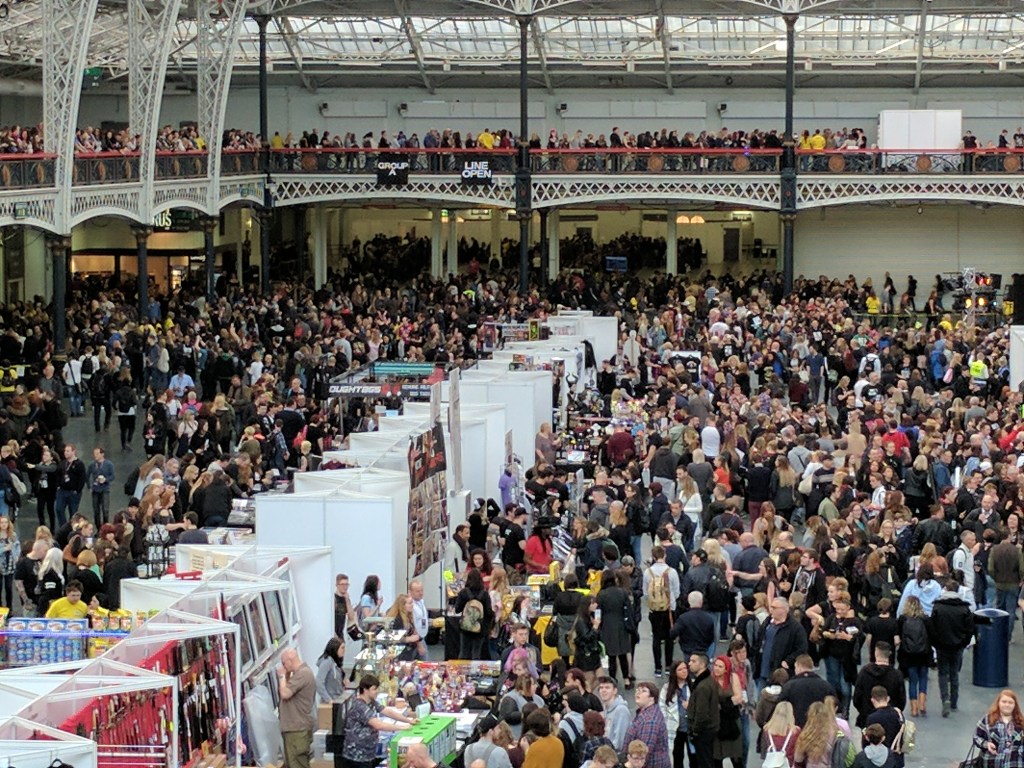
    A packed event hall. A lower level is full of attendees and separated by a line of pipe-and-drape vendor booths. An upper balcony is also full of people.
    Image description: A packed event hall at Walker Stalker London 2016. The lower level is divided by vendor booths. Crowds of people move along both sides, filling the floor. In the back underneath a balcony, the photo ops area is visible. The balcony itself is lined with people waiting for autographs at celebrity guest booths.

    The technician for the lobby lift did not arrive, however. Not that day, not that weekend, and not once in the three years that we held conventions in that venue. The lobby lift was always broken and the promised technician never showed. The venue assured me each time that the lift had most certainly been working just the weekend before, but the group just before us had broken it during their load-out. Meanwhile, the Out of Order sign faded from a cheerful sunflower yellow to a pale listless beige as its laminated corners warped and crinkled in on themselves in shame, leaving black tape outlines behind.

    The lobby lift was just the beginning of what I came to call “The Great British Lift-Off.” You see, the exhibit hall we occupied has two levels, and we utilized every inch. Attendees visited vendors and photo ops on the bottom level, then they went upstairs for the panel room and celebrity autograph booths. Halfway down the right-hand wall, nestled right between the bathrooms, was the sole passenger lift.
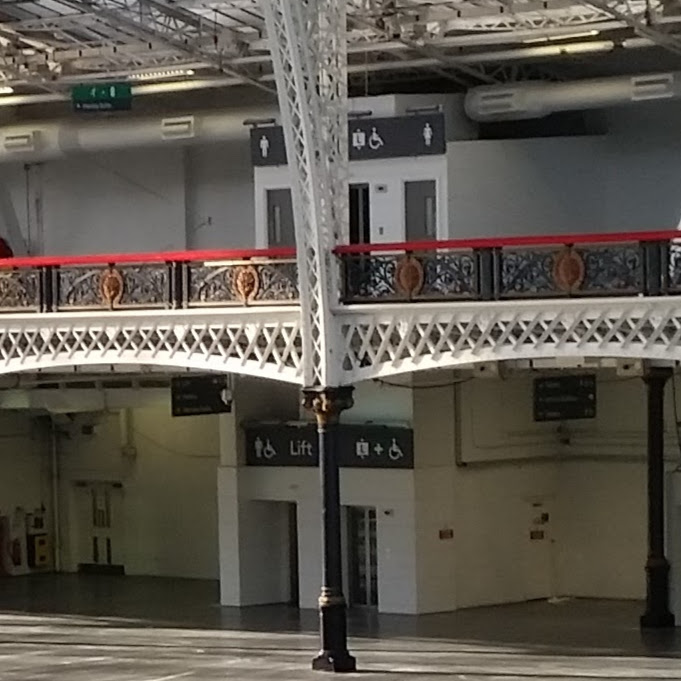
    An elevator in an event hall. There is an elevator entrance visible on two floors. On the bottom level, a black sign above the elevator reads "Lift" with handicapped icons next to it. A similar sign is above the elevator entrance on the top floor.
    Image description: an elevator bank in an event hall. There is an elevator entrance visible on two floors. On the bottom level, a black sign above the elevator reads “Lift” with handicapped icons next to it, along with a sign for a men’s restroom. A similar sign is above the elevator entrance on the balcony with signs for both men’s and women’s restrooms.

    This elevator was twice the size of the lobby lift, which means it was roughly the same size as a medium packing box from the UPS Store. Its stated capacity was 22 people. At no point in all of the time I spent at this venue did the elevator hold 22 people. In fact, it rarely held even one.

    Not because the elevator was broken. Oh no- this elevator was made of sterner stuff than that shabby lobby lift. It would take more than a misdirected road crate or two to break it down. It was a passenger lift and it was ready to do its job of uplifting the masses. Just as soon as someone from the venue actually turned it on.

    The real elevator battle came down to a literal power struggle. As a staff member proudly told me, the venue was part of a national energy-saving program and had been charged with reducing its energy usage as much as possible. A list of power-saving ideas had accompanied this directive. Near the top of that list was the suggestion, “turn off elevators outside of business hours.” Someone at the venue with a lot of decision-making authority but very little global perspective had decided that meant *their* business hours. At 6 pm every Friday, the elevator was switched off. The staff member did not work on the weekends, so neither should the elevator.

    Unfortunately, quite a few of our attendees’ legs also didn’t work on the weekends (nor during the rest of the week for that matter). The signs with peppy phrases like “take the stairs- your heart will thank you and so will our electrical grid!” and “Give your step count a lift- stairs are located just round the corner” taped to the unlit glass doors were not as encouraging as their designers probably intended. Several dozen people who had paid a full ticket price (at least two of them had the top-tier Platinum VIP pass) were now left barred from over half of the experience, and that was after they had already had a second-class experience getting into the hall.

    The good news is that even at that first show, the venue was already so eager to avoid any more elevator-related conversations with me that they actually did call a real, live elevator technician. Said technician arrived within 30 minutes of the call, flipped a switch, confirmed that the elevator was operational, and went on his merry way. (He did not look at the lobby lift. He was not there for the lobby lift. It was a Saturday morning and he was there for one elevator and one elevator alone. Honestly, good for him. May we all be so firm in holding to our work boundaries.)

    Like the lobby lift, this scene would play out at every one of our five shows through 2019. The venue was always very surprised that we expected the passenger lift to be operational for the full weekend, and they’d have to call an off-hours technician to turn it back on every Saturday morning. I don’t know how much the venue saved in elevator electricity costs throughout the rest of the year, but I can’t imagine that it did much to offset those emergency technician bills.

    There are two morals to this story: 1) disability access decisions should not be controlled by just one person, and 2) make sure that more than one person at your event knows which switch controls the elevator.
  •  To put it mildly, I am not an auditory learner. It’s not that things go in one ear and out the other. It’s that things don’t often make it through one ear. I need to read things in order for information to stick. I look up lyrics to songs on the radio. The captions are permanently on for my TV. I’m the person responsible for the “someone has enabled captioning” pop-up in work Zoom meetings. I request copies of PowerPoint slides in advance. I use an auto-captioning app on my phone for large in-person meetings. I’m on a personal mission to make as much of my world written down as possible. Please do not ask me for podcast recommendations. I don’t have them.

    What I do have, though, is a very deep love for reading and a fairly deep list of book recommendations. Here are my five favorite non-fiction disability-focused books and why I think everyone should read them.

    1. The Spirit Catches You and You Fall Down by Anne Fadiman. The book details the true story of a Hmong girl who was born in the US to immigrant parents. She was diagnosed with epilepsy as an infant in 1982, and the book follows the four year battle between her parents, who viewed her epilepsy from a traditional Hmong animistic viewpoint, and her Western medical team who viewed her parents’ actions as medical neglect. The book is a great examination of the clash between moral and medical models of disability, and it’s very fair to both sides.
    2. The Scalpel and the Silver Bear is the autobiography of Dr. Lori Arviso Alvord, the first Najavo woman surgeon, and her work to combine traditional Najavo beliefs and practices with Western medical advances. This is another good look at the often-explosive interactions of the moral and medical models of disability. It is especially interesting that both viewpoints are coming from the same person.
    3. The Immortal Life of Henrietta Lacks by Rebecca Skloot is a great book (& movie) about the intersection of disability, race, and socioeconomic status in medicine. Henrietta Lacks was a Black woman from a poor tobacco-farming community. She was diagnosed with cervical cancer in 1951. Cells from her tumors were harvested for research purposes without her knowledge or consent. Those harvested “HeLa” cells became the first immortal self-replicating line of human cells. They were instrumental in developing the polio vaccine and they are still used in cancer research today. Henrietta’s cancer cells are responsible for untold numbers of lives saved, but very few people knew her name before the book was written. Not even her family knew of the impact their mother, sister, wife, and grandmother has posthumously had on the field of medicine.
    4. Haben: The Deafblind Woman Who Conquered Harvard Law is written by Haben Girma. She is a civil rights attorney and advocate. She is the child of Eritrean and Ethiopian parents and she was born Deafblind. Her book predominately examines the educational system and how it talks to and about kids, teens, and adult students with disabilities. It also dives into the intersection of race and disability and explores the differences between US and foreign cultural attitudes.
    5. Being Seen: One Deafblind Woman’s Fight To End Ableism is by Elsa Sjunneson. Elsa is also Deafblind from birth, and she is an award-winning science fiction author. Like Haben, Being Seen simultaneously explores and challenges societal expectations on how disabled people should live and behave. The book dives deep into the intersectionality between disability, gender, and sexual orientation.

  • Seeing The Unseen

    “Look, I’ve been doing this for 20 years. There just aren’t that many disabled people in Australia.”

    The person who said this to me in late 2017 was wrong, of course. There are “that many” disabled people in Australia, and I took great satisfaction in proving it to him a few months later over the course of two summery February weekends. But the attitude behind his words- “I haven’t seen it, so it must not exist” remains universally common. It’s impact on disability access is catastrophic.

    Disability is context-specific. The presentation and severity changes based on the situation. I have a vertigo disorder. I can walk down a hallway just fine, but put me on an elevator for more than 10 stories or on the top floor of a building built to sway in the wind and you’ll see the impact of my malformed inner ear. My best friend has POTS and EDS. She can build you an entire fantasy world out of words, but re-organizing just one of her many bookshelves can leave her bedridden for days. How disabled she and I “look” at any given moment depends heavily on our environment. This is true for nearly every disabled person that I have met, and I’ve met a lot in my 13 years of experience at 100+ events.

    When the environment is inaccessible, one of two things happens. Sometimes you see a sharp increase in severity. This can look like more people needing priority seating on the bus, more people struggling to regulate themselves and their behavior in crowds, and more people applying for IEPs and 504 plans at school. This sometimes gets attributed to people faking or playing up a disability to get special treatment. I can say that 99.9% of the time, it’s because people are more stressed out and disabled bodies betray us way quicker when they’re stressed.

    The other thing that happens is that disabled people don’t show up at all. When you live with a chronic disability, you get really good at looking up information ahead of time. You also get really good at spotting clues that a place or event is not going to be accessible for you. Being disabled is hella expensive (that’s a post for another time), so when you know that attending is going to bring you more misery and pain than joy, you save those few spare dollars. You become part of an audience that is never seen and never counted.

    If you are not pulling in disabled people to your space, it is not because we do not exist. It is because your space is not accessible and we know it. When you build an accessible environment, you will find your missing audience. This story does have a happy ending. That tour promoter watched my team and I serve 150 disabled attendees on the first weekend of our two-week run and over 250 on the second, accounting for nearly 10% of the total convention attendance. After the last panel on the last day, he sat down next to me on the edge of the stage where I was chatting with the AUSLAN interpreters whose hiring had sparked the situation. He glanced over the still-heavy crowd of people in the convention hall, all busy queuing for that last autograph or perusing the vendor alley for the perfect collectible. Then he looked at me and said the other phrase that still echoes in my head 7 years later: “you were right.”

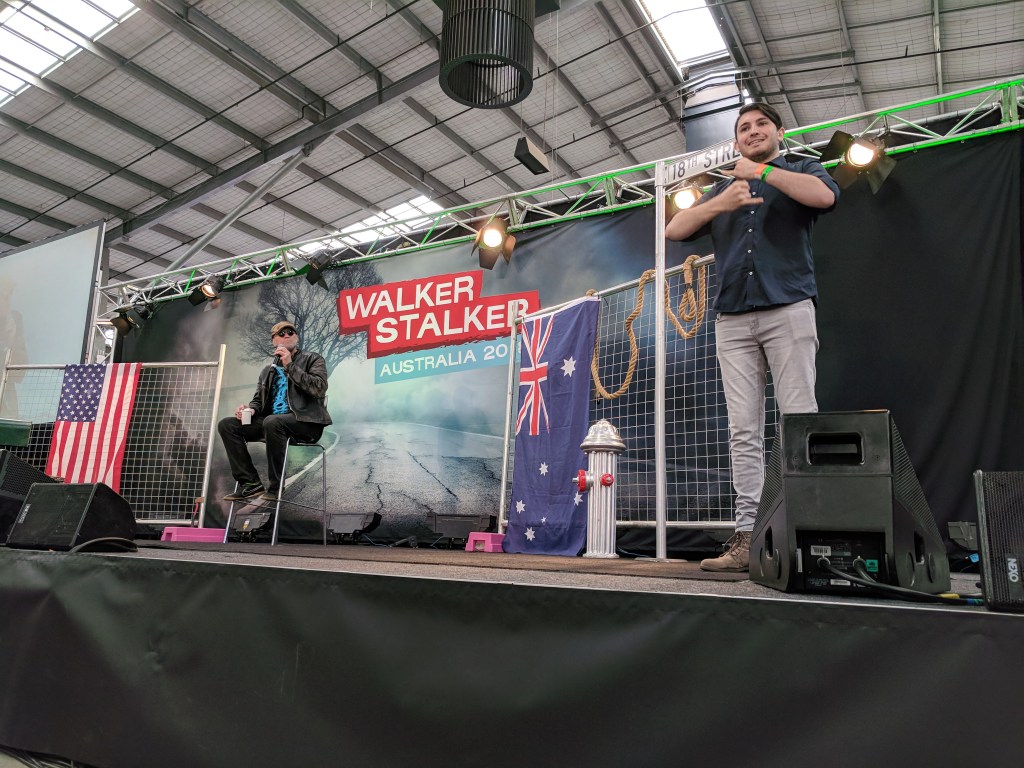
    Actor Michael Rooker sits in a chair on a stage and looks at a dark-haired white man standing to his right. The man is smiling and making a sign in AUSLAN.
    Image Description: Actor Michael Rooker sits in a chair on a stage and looks at a dark-haired white man standing to his right. The man is smiling and making a sign in AUSLAN.